Introduction
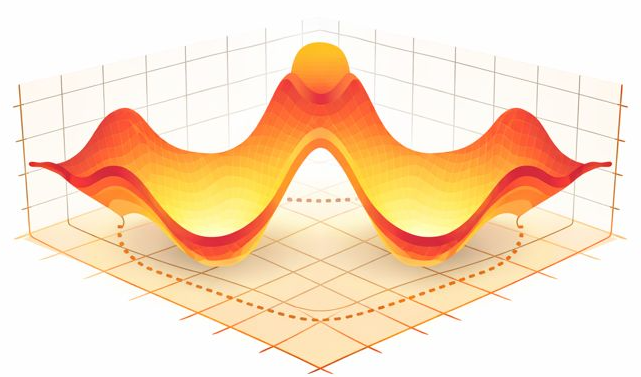
Free Energy Surfaces (FESs) are low-dimensional representations of the thermodynamic stability of ensembles of atomic configurations. As such, FESs are valuable tools for mapping, rationalising, and navigating the inherent complexity of high-dimensional datasets generated by sampling atomistic models through simulations that build on Molecular Dynamics and Monte Carlo techniques Frenkel & Smit, 2023Tuckerman, 2023Chandler, 1987. Enabling a direct connection between the microscopic world of atomic configurations and interpretable, macroscopic observables, the ability to compute, read, and interpret FESs is crucial for the quantitative interpretation of atomistic simulation results, and thus also for the adoption of molecular simulation techniques in an engineering context. Our goal in this review is to provide a route to computing, reading, and interpreting FESs, first by establishing the theoretical foundations, then by surveying practical methods for their calculation, and finally by demonstrating how modern machine learning enhances both the representation and sampling of FESs. Section sec:Theory introduces the statistical--mechanical basis of FESs, linking partition functions and thermodynamic potentials to marginal probabilities, and showing how projections onto collective variables (CVs) yield interpretable landscapes. Key aspects include ergodicity, CV selection, and how FESs provide barrier heights and equilibrium constants. Section sec:Computing outlines practical computational techniques aimed at evaluating FESs from molecular simulations. Section sec:MLCVs explores machine learning in the analysis and calculation of FESs, providing an overview of recent developments, from machine-learned CVs and variational committor models to ML-enhanced transition-path sampling, and highlights how learning and sampling can be integrated to improve the representation and exploration of molecular processes.
- Frenkel, D., & Smit, B. (2023). Understanding Molecular Simulation: from Algorithms to Applications (3rd ed.). Elsevier. 10.1016/C2009-0-63921-0
- Tuckerman, M. (2023). Statistical Mechanics : Theory and Molecular Simulation. Oxford University Press. 10.1093/oso/9780198825562.001.0001
- Chandler, D. (1987). Introduction to Modern Statistical Mechanics. Oxford University Press.